
AI Transformation Is a Problem of Governance in This Modern Era
-
 by
by
- in Technology

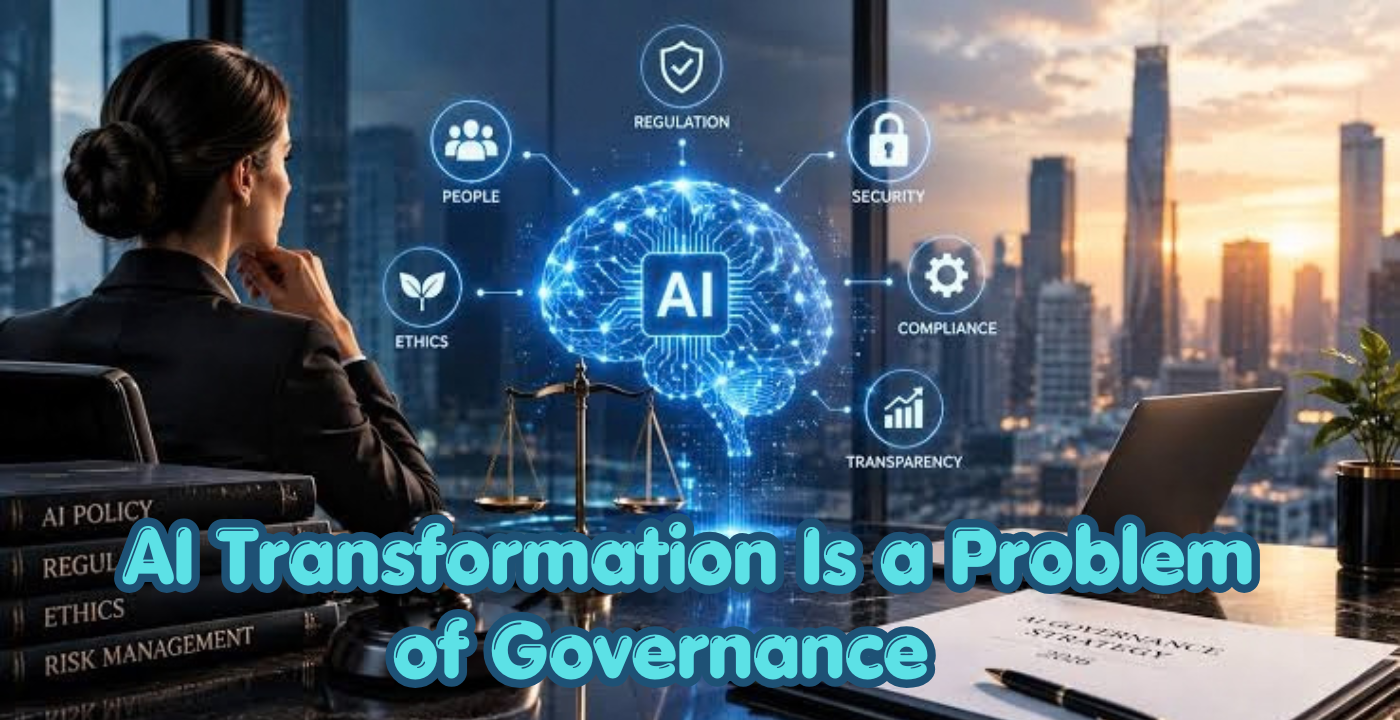
Open your phone right now and think about what’s actually running on it. Something is finishing your sentences, editing your photos, or telling you what video to watch next. A decade ago this would’ve sounded like a movie plot. Today it’s just an ordinary Tuesday. And yet, for all the excitement around artificial intelligence, there’s an uncomfortable truth that rarely gets said out loud: the biggest challenge with AI isn’t the technology itself. It’s the rules — or more honestly, the lack of them. AI transformation is a problem of governance, and the sooner we accept that, the better off we’ll all be.
What “Governance” Really Means
The word governance sounds like something lifted from a stiff boardroom meeting, but strip it down and the idea is almost embarrassingly simple. Governance is about who makes the rules and who answers when things go wrong. When we apply that idea to AI, the questions that actually matter start to come into focus. Who decides how this technology gets used? Who profits from it, and who pays the price when something breaks? No algorithm on earth can answer those questions, because they’re not technical problems at all — they’re deeply human ones, and they belong to us.
Why Better Tech Doesn’t Mean a Better World
There’s a stubborn myth worth pushing back on here, and it’s the belief that better technology automatically builds a better world. History has never once worked that way. Electricity changed civilization, but it only became safe and genuinely useful after we agreed on wiring standards and safety codes. Cars reshaped entire cities, yet that transformation came with licenses, seatbelts, and speed limits. Even the internet — AI’s closest cousin — needed privacy laws and cybercrime rules before people could really trust it. The pattern never changes. Powerful technology plus weak rules equals chaos, not progress.
The Problems Already Knocking at the Door
Governance failures around AI aren’t some future worry — they’re happening right now. Take bias, for instance. AI systems learn from human data, and human data carries every prejudice we’ve got. Back in 2018, researchers found that widely used facial recognition tools made far more errors on dark-skinned women than on light-skinned men. That was alarming on its own, but imagine the same flawed tech deciding who gets a job interview or who gets stopped by police. Without oversight, bias doesn’t just survive — it multiplies at a scale no human could match alone.

Then there’s the strange new world of things that look real but aren’t. AI can now generate videos of real people saying words they never spoke, and these deepfakes have already turned up in elections around the world. When you can’t trust your own eyes anymore, how does a society share a common reality? No software update fixes that. Only strong laws, reliable verification tools, and a public that questions what it sees can hold the line.
Privacy deserves its own mention, too. AI runs on data — mountains of it, most of it collected from ordinary people without them fully realizing. Where you shop, what you search, how you type, even how you drive. Europe pushed back with the GDPR, forcing companies to get clear consent before collecting personal information, but huge parts of the world have nothing comparable. That’s not a technology gap; it’s a governance gap, and regular people are the ones falling into it.
And what about accountability? When an algorithm denies someone a loan, or a self-driving car causes an accident, who is actually responsible? The programmer? The company? The owner? In many places, the honest answer today is a shrug. Without clear laws, responsibility becomes a game of hot potato, and the people who get hurt have nobody to turn to.
The Messy Global Picture
As of 2026, there is still no worldwide agreement on managing AI, and that makes everything harder. The European Union passed its AI Act — the first comprehensive law of its kind — which bans clearly harmful uses like social scoring and puts strict limits on AI in hiring and healthcare. The United States has taken a lighter route, mixing executive orders with voluntary promises from big tech firms. China regulates aggressively but focuses mostly on controlling information. Meanwhile, a huge number of countries, especially developing ones, have almost no AI-specific laws at all. This patchwork matters because companies naturally drift toward wherever the rules are loosest, and global threats like AI-powered cyberattacks don’t stop at borders anyway. No single country can solve this alone.
Won’t Rules Kill Innovation?
Some people argue that heavy regulation will smother progress, and that worry isn’t entirely wrong — badly written rules can bury small startups in paperwork while giants sail through untouched. But the opposite argument carries real weight too: trust is the fuel of adoption. People board airplanes precisely because aviation is one of the most heavily regulated industries on the planet. Sensible AI rules create that same confidence. The sweet spot is balance — strict oversight for high-stakes uses like medicine and criminal justice, and a lighter touch for everyday, low-risk tools.
What Good AI Rules Would Look Like

Organizations like the OECD and UNESCO have already sketched the blueprint, and their ideas are refreshingly simple. People deserve to know when they’re interacting with a machine rather than a human. A person should always oversee decisions that change lives. AI systems should be tested for bias before launch and monitored after. The law should clearly name who’s responsible when things break. And countries need to cooperate, because the internet never respected borders and AI won’t either. None of this is revolutionary — it’s common sense, which makes it all the more frustrating that we’re still struggling to put it into practice.
Final Word
AI will shape this century one way or another, and that’s not up for debate. What is still up for debate is whether it lifts everyone up or concentrates power in a handful of corporate hands — and that depends far less on the technology than on the rules we wrap around it. So the next time an AI headline crosses your screen, skip the “wow” and ask a harder question instead: who’s watching over this thing, and who decided they get to? Because at the end of the day, AI transformation is a problem of governance — and governance, for better or worse, is entirely on us.
Read More: What Is EnterTechPro and Why Do People Keep Using It?

No comment